

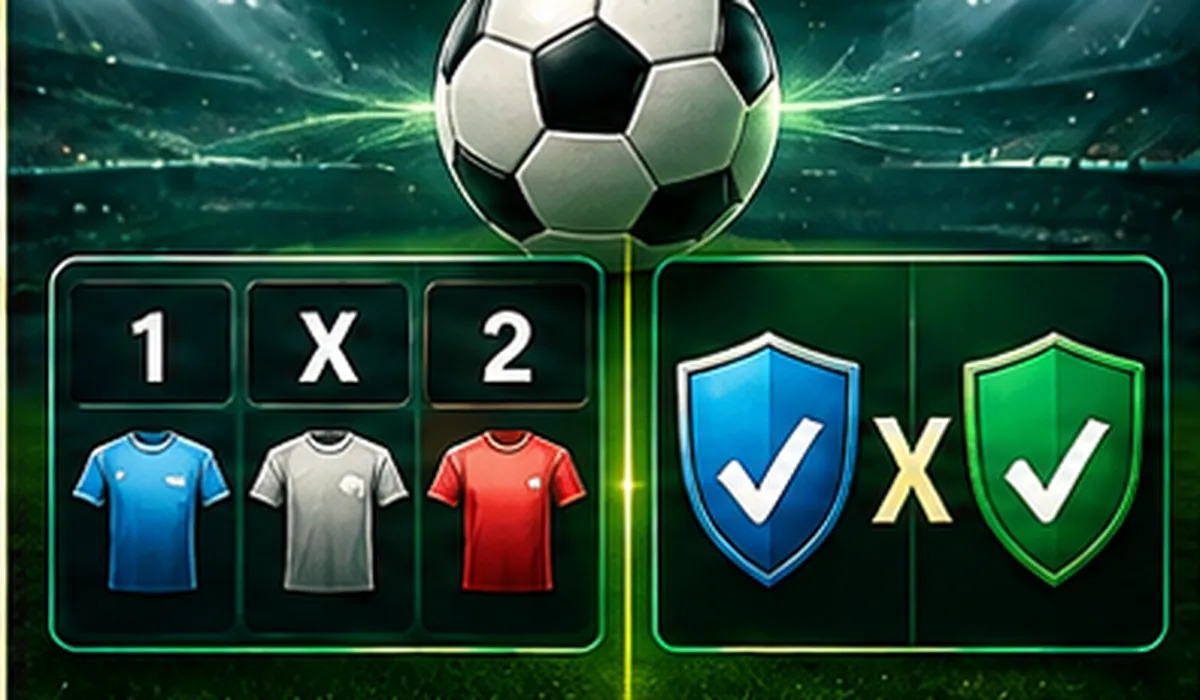
1X2 and Double Chance are football match-result markets. 1X2 asks you to choose one of three outcomes: home win, draw, or away win. Double Chance combines two of those three outcomes into one selection, giving the bet two ways to settle as a winner.
The tradeoff is straightforward: covering more outcomes normally produces shorter odds than selecting only one result.
What 1, X and 2 mean
In football betting notation:
- 1 = the listed home team wins;
- X = the match ends in a draw;
- 2 = the listed away team wins.
These markets are commonly settled on the result at the end of regulation time plus stoppage time unless the sportsbook states otherwise. Extra time and penalties usually do not count for a standard 90-minute match-result market.
Always verify the sportsbook’s market label.
What Double Chance means
Double Chance combines two results:
- 1X = home win or draw;
- X2 = draw or away win;
- 12 = home win or away win, so a draw loses.
Bet365’s current soccer rules describe these same three Double Chance options and note that standard match settlement is based on the stated regulation period unless otherwise specified.
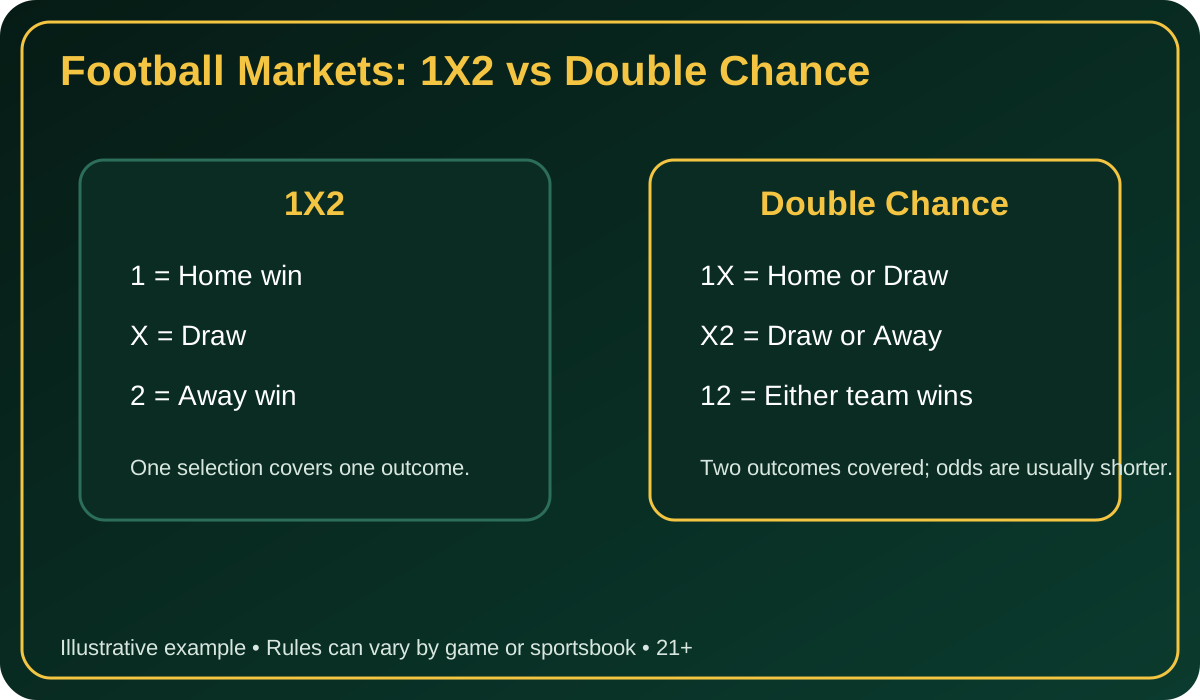
Read diagram text
- Football Markets: 1X2 vs Double Chance
- 1X2
- 1 = Home win
- X = Draw
- 2 = Away win
- One selection covers one outcome.
- Double Chance
- 1X = Home or Draw
- X2 = Draw or Away
- 12 = Either team wins
- Two outcomes covered; odds are usually shorter.
- Illustrative example • Rules can vary by game or sportsbook • 21+
Practical Example
Match: Manila FC vs Cebu FC.
Final score after regulation: 1–1.
| Selection | Result |
|---|---|
| 1 | Loses |
| X | Wins |
| 2 | Loses |
| 1X | Wins |
| X2 | Wins |
| 12 | Loses |
The draw is included in 1X and X2 but excluded from 12.
Why Double Chance odds are usually shorter
A 1X2 selection covers one outcome. Double Chance covers two.
If a bettor selects 1X, the bet can win through either a home victory or a draw. Because the selection survives more possible final results, the sportsbook generally offers a lower price than a home-win-only bet.
This is not a “free safety” feature. The shorter price is the cost of covering the second result.
1X2 vs Draw No Bet
Double Chance and Draw No Bet are often confused.
A typical Draw No Bet market removes the draw as a losing outcome: if the selected team wins, the bet wins; if the match is drawn, the stake is returned; if the selected team loses, the bet loses.
By contrast, 1X treats both a home win and draw as winning outcomes.
That difference changes both settlement and odds.
12 is not the same as “either team to score”
The 12 selection means the match must produce a winner within the market’s settlement period. It loses on a draw.
It does not matter which team scores first, how many total goals are scored, or whether both teams score. Those are different markets.
A 0–0 draw makes 12 lose. A 5–4 result makes 12 win. A 1–1 result makes 12 lose.
Neutral venues
Sportsbooks can still label one team as “home” and the other as “away” for betting purposes even at a neutral venue.
Bet365’s current rules state that when a match is played at a neutral venue, the team listed first is treated as the home team for Double Chance settlement.
This is why bettors should use the sportsbook listing, not the stadium location, when interpreting 1 and 2.
Practical Example with hypothetical odds
Suppose a book displays:
- Home win (1): 2.40
- Draw (X): 3.20
- Away win (2): 2.90
- Home or Draw (1X): 1.42
A ₱1,000 stake at 2.40 has a higher potential return than ₱1,000 at 1.42, but the 1X ticket covers the draw as well.
The example shows the tradeoff between coverage and price. It is not a recommendation to select either market.
What to check before placing the bet
Confirm:
- regulation-time vs qualification market;
- whether extra time counts;
- which team is listed as 1 or 2;
- neutral-venue treatment;
- postponement rules;
- whether the selection is pre-match or live;
- the current odds before confirming.
Live markets can be suspended and repriced after goals, red cards, VAR events, or other major changes.
Common mistakes
Thinking X means the away team. X represents the draw in 1X2 notation.
Assuming Double Chance doubles the payout. It combines outcomes; it normally shortens the odds.
Confusing 12 with Draw No Bet. 12 loses on a draw; DNB usually returns the stake on a draw.
Including extra time automatically. Standard 90-minute markets often exclude it.
Reading 1 and 2 from the physical venue. Use the sportsbook’s listed home/away order.
When each market is easier to read
1X2 is the cleaner market when the bettor wants one exact match-result outcome. Double Chance is easier when the bettor wants a selection that remains alive across two outcomes.
Neither market removes sportsbook margin or makes a prediction certain.
Related ScatterPanalo Reading
Implied probability and why the price changes
Odds are a price, not just a payout label. When a selection covers more possible results, the sportsbook can offer a shorter price because the ticket has a higher chance of surviving the final score before margin is considered. This is why 1X normally pays less than a home-win-only selection on the same match.
For a simple illustration, decimal odds of 2.00 correspond to a raw implied probability of 50% before adjusting for the bookmaker margin. Decimal odds of 1.40 correspond to about 71.4%. These figures do not tell the true probability on their own because a sportsbook builds margin into the market, but they show why broader coverage is normally priced lower.
Double Chance vs combining two separate 1X2 bets
A reader might wonder whether betting Home and Draw separately is the same as selecting 1X. The covered outcomes can be similar, but the stake allocation and offered prices can make the final return different. A Double Chance market is quoted as one selection with one price. Two separate 1X2 bets require the bettor to divide the stake and calculate each return independently.
Because the bookmaker prices each market separately, do not assume the two methods produce identical value. Compare the total stake and possible return rather than just the covered outcomes.
Live 1X2 and Double Chance
In-play prices can change after goals, red cards, injuries, or large swings in match state. A 1X offer that looked attractive before kickoff may be unavailable or priced very differently after the home team scores. A live Double Chance ticket is settled according to the market and period shown at the time the wager is accepted, not the pre-match price remembered by the bettor.
Competition and knockout wording
Cup matches create an extra trap because the team that “qualifies” can differ from the team that wins the 90-minute 1X2 market. A match can be drawn after regulation and later decided in extra time or penalties. A standard X selection can therefore win even though one team eventually advances. If the sportsbook offers “to qualify,” “draw no bet,” or “winner including extra time,” those are separate markets.
Interface cue to watch
Some sportsbooks place 1X2 near Double Chance in the same market group, while others hide Double Chance under an expanded list. The bet slip is the final confirmation: it should show the exact selection, event, market period, odds, and stake before submission. If the slip says “To Qualify” instead of “Double Chance,” it is a different market.
Key takeaway
1X2 is a three-outcome market with one chosen result. Double Chance is a two-outcome coverage market built from the same 1/X/2 results. The extra coverage normally comes with shorter odds, so settlement and price should be read together.
FAQs
What does 1X mean?
Home win or draw.
What does X2 mean?
Draw or away win.
What does 12 mean?
Either team wins; a draw loses.
Does extra time count?
Usually not for a standard 90-minute match-result market unless stated.
Is Double Chance safer?
It covers more outcomes, but the odds are usually lower and the bet can still lose.
Responsible Betting
Betting markets do not guarantee profit. Odds change, selections lose, and settlement rules matter. Set a stake limit, avoid chasing losses, and use sportsbook limit or self-exclusion tools when needed. 21+ only.
Sources
- bet365 soccer rules: Double Chance
- bet365 football market explainer
Mga sanggunian at dagdag na mapagkukunan
PAGCOR resource links checked: . Ang mga link na ito ay resources; hindi endorsement o personal game testing.