

Direct Answer
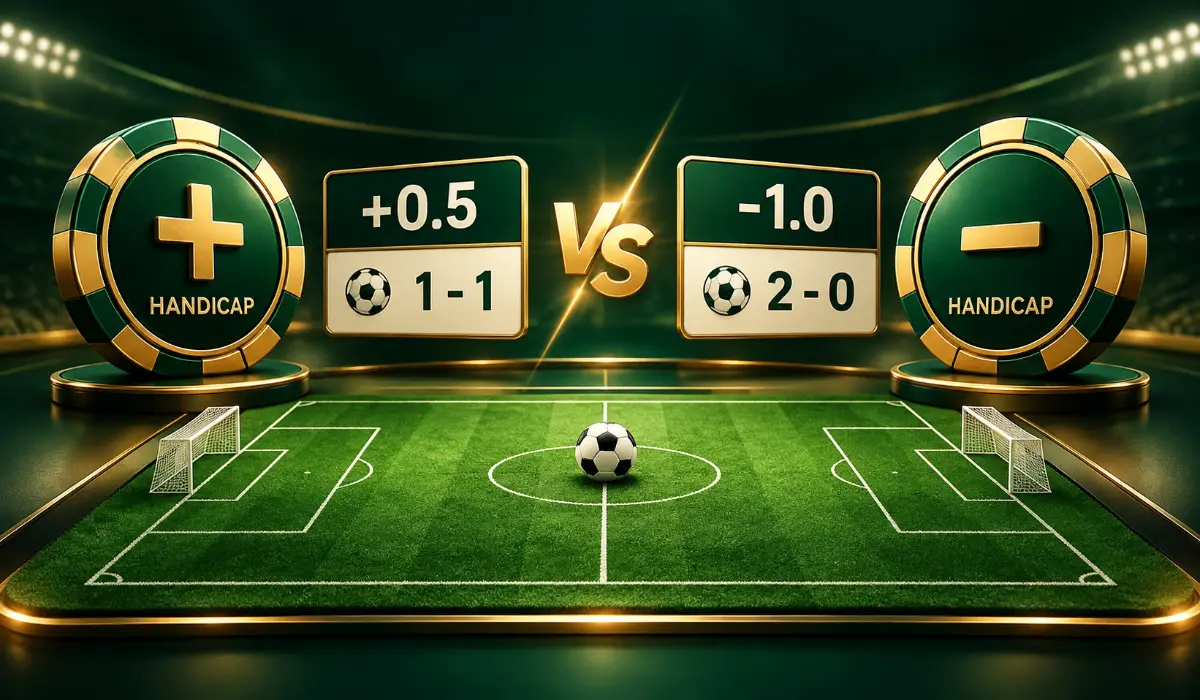
Asian handicap betting applies a virtual head start or deficit to one side for bet settlement. It is commonly used in football Sports Betting to remove or reduce the draw outcome.
Para sa kaugnay na paliwanag, basahin ang Sports Betting: Odds, Markets at Responsible Betting.
The actual match score does not change; only the settlement calculation uses the handicap.
Read the sign from the selected team’s perspective: a minus line requires that team to overcome a deficit, while a plus line gives it a settlement head start. The practical challenge is recognizing which part of a split stake wins, loses or returns when the score reaches a boundary.
Visual Example: Half Line
⚽ Team A  -0.5
⚽ Team B  +0.5

Actual score: Team A 2–1 Team B
Adjusted for Team A -0.5: 1.5–1
In this fictional example, Team A still finishes ahead after the handicap adjustment.
Whole-Goal Lines
A whole-number handicap such as 0, +1, or -1 can allow a push depending on the final adjusted result and sportsbook rules.
Example:
Team A -1
Actual score: 2–1
Adjusted score: 1–1
This commonly results in a push for the handicap selection, but readers should always check the operator's settlement rules.
Quarter-Goal Lines
Quarter lines such as -0.25, +0.25, -0.75, or +0.75 effectively split the stake across two adjacent handicap lines.
Example:
-0.25 = half stake on 0 + half stake on -0.5
This is why quarter handicaps can produce half-win or half-loss settlement outcomes.
What Readers Should Check
Before placing a handicap bet, the bettor should verify:
- the exact handicap line;
- whether the market includes extra time;
- event settlement rules;
- void/push treatment;
- how quarter lines are split;
- whether odds changed before confirmation.
Read the accepted selection before calculating
Write down the team name, handicap sign, line, accepted decimal odds and covered period. Team A -1 is not interchangeable with Team B -1, and Team A +1 is the opposite side of the handicap from Team A -1. A market screen can move after acceptance; the confirmed ticket is the record of the line you bought.
For the examples here, assume a pre-match football Asian handicap settled on the completed regulation-time score, with no bonuses, taxes or commission. Exact rules can vary by provider or operator, so confirm the market period and settlement conditions. In-play handicaps need particular care because a product can use the remaining score rather than the full match score.
A useful calculation: goal difference plus handicap
Take the selected team's goals minus its opponent's goals, then add the handicap. For a single line, a positive result wins, zero pushes and a negative result loses under the stated Asian-handicap model.
If Team A wins 2–1, its goal difference is +1. Team A -0.5 produces +0.5 and wins; Team A -1 produces 0 and pushes; Team A -1.5 produces -0.5 and loses. The same official result can therefore settle three handicap lines differently.
A push returns the eligible stake without winning profit. It is not a prediction that the official match will be drawn. For the account-status distinction, see void, push and refund explained.
Practical Example 1: quarter lines on a drawn match
Imagine a 200-unit stake at decimal odds 1.90 on Team A -0.25. Split it into 100 units on Team A 0 and 100 on Team A -0.5. The actual match finishes 1–1.
The 0 part pushes, returning 100. The -0.5 part loses its 100. Total returned is 100 from an original 200, so the net loss is 100: a half loss. It is not a full refund simply because one component pushed.
Now consider a separate 200-unit ticket on Team A +0.25 at the same illustrative odds. That splits into 100 on 0 and 100 on +0.5. With the same 1–1 score, the 0 part returns 100 and the +0.5 part returns 190, including its stake. Total returned is 290, or 90 net profit: a half win.
The two examples demonstrate opposite handicap signs; they are not a recommendation to hold both tickets. The displayed odds are invented solely to make the settlement arithmetic visible.
Practical Example 2: -0.75 when the selected team wins by one
Split a fictional 200-unit stake on Team A -0.75 at 1.90 into 100 on -0.5 and 100 on -1. If Team A wins 2–1, the -0.5 component wins and returns 190, while -1 pushes and returns 100. Total returned is 290 and net profit is 90.
If Team A instead wins by two goals, both components win and the 200-unit stake returns 380. If Team A draws, both components lose. A half-win outcome occurs at a specific result boundary, not whenever the team performs “quite well.”
| Quarter line | Equal stake split | Boundary result for selected team |
|---|---|---|
| -0.25 | 0 and -0.5 | Draw: half loss |
| +0.25 | 0 and +0.5 | Draw: half win |
| -0.75 | -0.5 and -1 | Win by one: half win |
| +0.75 | +0.5 and +1 | Lose by one: half loss |
For every row, settle the two component lines separately before adding the returned amounts. That method is more reliable than memorizing a phrase such as “quarter lines are safer.” They change the settlement boundary and price; they do not guarantee a smaller loss on every result.
Handicap zero, draw-no-bet and three-way handicaps
In the ordinary completed-match model, Asian handicap 0 has the same win/draw/loss treatment as a draw-no-bet selection on that team: win pays, draw returns stake, defeat loses. Compare the actual terms and price rather than assuming similarly named products are identical in every circumstance.
The separate moneyline versus draw-no-bet guide covers that comparison in more detail. A three-way European handicap is different: it includes an adjusted-draw selection. An adjusted tie can therefore be a winning third outcome instead of a push. Check whether the market offers two selections or three before applying this article's arithmetic.
Price, return and amount at risk
The decimal price applies to the winning stake component. With a half win, do not multiply the full stake by the odds and then add a refund: that counts some money twice. Add the winning half's gross return to the pushing half's stake return, then subtract the full original stake.
Keep a written distinction between gross return and net profit. A 290-unit return on a 200-unit wager is a 90-unit gain, not a 290-unit gain. A 100-unit return on that wager is still a 100-unit loss even though the account received money back.
Mistakes that change the answer
- Copying a handicap from the opponent's column instead of the selected team's column.
- Treating a quarter line as a literal quarter-goal event rather than two stake components.
- Applying full-match scores to a remaining-time in-play market.
- Assuming a half-goal line and a whole-goal line share the same push condition.
- Reading a cash-out quote as the final handicap settlement amount.
Save the accepted ticket before relying on a price comparison. If an event is interrupted, determine whether the bet remains valid before doing normal completed-match arithmetic. The Sports Betting hub links to the separate event-status and market guides without turning this page into a guide to every betting product.
FAQs
Is a half loss half of the possible profit?
No. In the examples above it means one half of the original stake loses and the other half pushes. Calculate the two stake components separately.
Is -0.75 the same as -0.5?
No. Half the -0.75 stake uses -1, so a one-goal win produces a half win rather than the full win on -0.5.
Why can the match winner still lose a handicap wager?
A minus handicap can require a larger winning margin. Winning 1–0 does not satisfy a -1.5 line.
Can I use the same formula on every live handicap?
Only after checking the scoring basis. Some in-play products use goals after acceptance rather than the full-match score.
Responsible Gaming Notice
Gaming is for persons 21 years old and above only. Gambling can be addictive. Know when to stop.
This article is educational and does not present gambling as a source of income or a guaranteed way to make money.
Sources and Verification Notes
- Betfair's Asian Handicap explanation documents whole, half and split-line mechanics for its Exchange product. Product-specific trading features are outside this guide.
- Pinnacle's Asian Handicap help page provides another operator reference, including its remaining-time in-play rule. Hypothetical amounts above illustrate arithmetic, not current prices or an available offer.
Rule references checked: 28 October 2026. These sources explain the stated formats; they do not establish licensing, availability or eligibility at a particular operator.
Mga sanggunian at dagdag na mapagkukunan
PAGCOR resource links checked: . Ang mga link na ito ay resources; hindi endorsement o personal game testing.