

Direct Answer
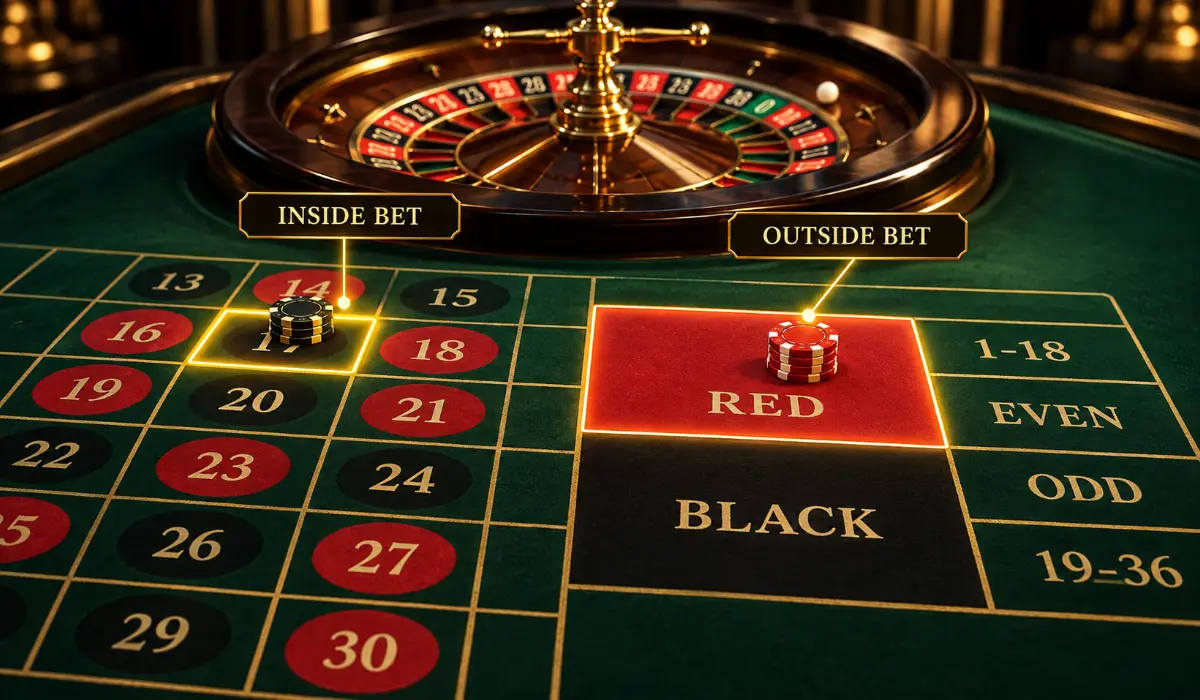
Inside bets cover individual roulette numbers or small groups of neighboring numbers on the main number grid. Outside bets cover larger groups such as red/black, odd/even, or broader number ranges.
Para sa kaugnay na paliwanag, basahin ang Table Games: Roulette, Blackjack at Baccarat.
The trade-off is generally between narrower coverage with larger listed payouts and broader coverage with smaller listed payouts.
The useful comparison is how many pockets a wager covers, what a winning ticket returns, and what the whole spin costs. “Outside” describes a location on the layout, not protection from loss. The examples below use ordinary single-zero roulette unless another format is stated.
Visual Example
INSIDE
🎯 17
🎯 17 + 20
🎯 small number groups

OUTSIDE
🔴 Red
⚫ Black
Odd / Even
1–18 / 19–36
The exact table layout and payout schedule should be checked in the game rules.
Inside Bet Examples
Common inside formats can include:
- straight-up number;
- split;
- street;
- corner;
- other small-number combinations.
Different roulette variants may display or name special bets differently.
Outside Bet Examples
Typical outside options include:
- red or black;
- odd or even;
- low or high;
- dozens;
- columns.
Zero is important because it affects many outside bets and is one reason roulette should not be described as an even 50/50 game.
Why Roulette Variant Matters
European, French, American, and other roulette variants can use different wheel layouts or special rules. A reader should verify:
- number of zero pockets;
- payout table;
- special rules;
- minimum and maximum bets;
- whether side bets are present.
Coverage and profit are separate numbers
A quoted payout such as 35 to 1 normally describes profit on the winning stake. A winning 10-unit straight-up wager at that rate produces 350 units of profit plus the returned 10-unit stake. The gross amount returned is 360, not 350. Always check whether the interface displays profit or total return.
The following is a conventional payout comparison, not a specification for every themed or multiplier version. Exact rules can vary by provider or operator, so use the table's own paytable when a special feature or different wheel is offered.
| Conventional wager | Pockets covered | Listed profit payout |
|---|---|---|
| Straight-up | 1 | 35 to 1 |
| Split | 2 | 17 to 1 |
| Street | 3 | 11 to 1 |
| Corner | 4 | 8 to 1 |
| Six-line | 6 | 5 to 1 |
| Dozen or column | 12 | 2 to 1 |
| Red/black, odd/even or low/high | 18 | 1 to 1 |
MGM Resorts' GameSense roulette guide documents the conventional bet types and payouts. A split or corner refers to adjoining positions on the betting grid; they are not necessarily neighboring pockets on the wheel. A wheel-neighbor bet is a separate arrangement whose component stakes need checking.
Practical Example: one result, different account effects
Imagine a single-zero table with the conventional payouts above. In separate hypothetical trials, place 20 units on red, 20 on the second dozen, or 20 straight-up on 17. The ball lands on 17, a black number within the second dozen.
The red ticket loses its 20 units. The dozen ticket wins 40 units profit and returns its 20-unit stake, for 60 back. The straight-up ticket wins 700 units profit and returns the 20-unit stake, for 720 back. These are three alternative tickets, not three predictions that can be made after seeing the result.
The larger straight-up payout accompanies narrower coverage. It is incorrect to compare 700 with 20 without also noticing that only one pocket satisfies the straight-up wager. Conversely, the dozen's broader coverage does not ensure a winning session.
Why zero matters even on a broad outside wager
For a simplified fair single-zero wheel with 37 equally likely pockets, red covers 18 pockets and black covers 18. The remaining pocket is zero. A red wager therefore covers 18/37 of the possible pockets, about 48.65%, rather than half the wheel.
With a conventional even-money red wager of one unit, the illustrative expected net result is 18/37 times +1 plus 19/37 times -1, or -1/37 unit. This is a long-run mathematical expectation for the stated model, not a prediction about the next 37 spins.
Under the same conventional single-zero assumptions, a straight-up wager has expected net result 1/37 times +35 plus 36/37 times -1, also -1/37 unit. Changing the shape of coverage changes the distribution of outcomes; it does not remove the zero-related disadvantage in this model.
An American double-zero wheel adds another zero pocket. Special zero rules or altered payouts require a fresh calculation. Do not carry the single-zero fraction into an unfamiliar game simply because the betting grid looks similar.
Practical Example: a winning chip can hide a losing spin
Suppose a fictional ticket contains 10 units on red and 10 straight-up on black 17. If another red number lands, the red wager returns 20 units and the straight-up wager returns nothing. The total placed was 20 and the total returned is 20, so the spin breaks even overall.
If a different black number lands, both selections lose and the total loss is 20. If 17 lands, the straight-up wager returns 360 and the red wager loses: the ticket's net result is 360 minus the total 20 placed, or +340.
This is why a highlighted winning chip is not a complete statement of profit. Add every stake on the layout, including repeated bets, wheel-neighbor components and optional side wagers, before comparing it with the total returned.
Common placement and comparison mistakes
- Putting a chip close to a line and assuming it covers the number you intended. Use the highlighted coverage preview before confirmation.
- Confusing a grid neighbor with a wheel neighbor.
- Calling every outside selection even-money; dozens and columns ordinarily have a different payout.
- Treating recent red results as proof that black is due.
- Doubling the next stake to recover a loss without accounting for total exposure and table limits.
The round-history explainer explains why recent outcomes are useful records rather than a schedule for future spins. This article compares ticket structure; it does not provide a staking system.
Before confirming a roulette ticket
Check the wheel's zero pockets, the payout attached to each selected area and the total amount on the layout. Read what the repeat button repeats: a multi-position ticket can cost more than the amount shown on an individual chip. Locate the undo and clear controls before the betting countdown starts.
For live tables, distinguish a chip placed on the visual layout from a wager actually accepted before betting closes. Keep the round reference if the account record differs from the confirmation. The general live casino guide covers that interface context, while the table-games guide helps keep roulette rules separate from card-game rules.
FAQs
Are dozens inside bets because they refer to numbers?
They are normally categorized as outside bets. Classification follows the betting layout and coverage type, not whether numbers appear in the label.
Does a winning chip mean the entire spin was profitable?
No. Compare all accepted stakes with the sum returned on all winning selections.
Can a wheel-neighbor wager contain several stakes?
Yes. Check the number of positions and total cost in the confirmation rather than treating it as one straight-up chip.
Does this payout table cover multiplier roulette?
No. A branded variant can alter payouts or add conditions. Use its own rules and paytable.
Responsible Gaming Notice
Gaming is for persons 21 years old and above only. Gambling can be addictive. Know when to stop.
This article is educational and does not present gambling as a source of income or a guaranteed way to make money.
Sources and Verification Notes
- MGM Resorts GameSense: Guide to Roulette documents conventional layout wagers and payouts. The ticket calculations here are hypothetical.
- Grand Ronde Gaming Commission game rules, roulette chapter, provide another official rules reference. Neither source establishes the rules of every locally offered table.
Rule references checked: 28 October 2026. These sources explain the stated formats; they do not establish licensing, availability or eligibility at a particular operator.
Mga sanggunian at dagdag na mapagkukunan
- MGM Resorts GameSense: Guide to Roulette
- Grand Ronde Gaming Commission game rules
- PAGCOR Responsible Gaming
PAGCOR resource links checked: . Ang mga link na ito ay resources; hindi endorsement o personal game testing.