

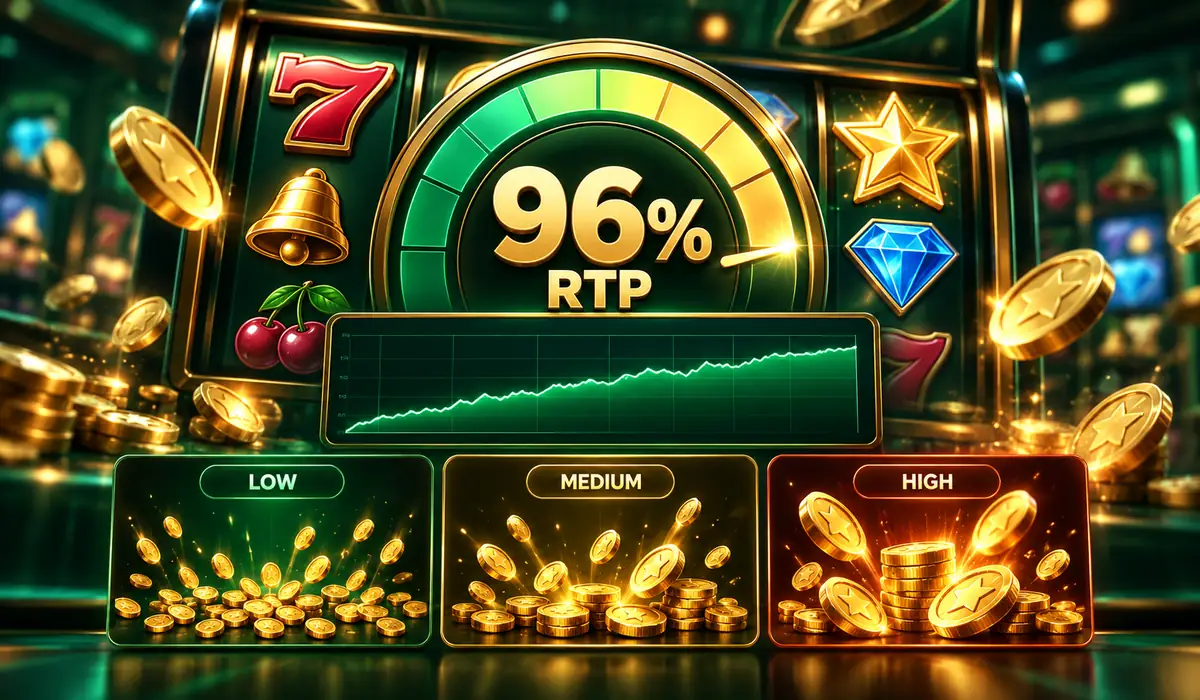
RTP at volatility ay dalawang magkaibang slot terms. Ang RTP ay theoretical long-run return percentage ng isang game configuration, habang ang volatility ay tumutukoy sa general pattern kung gaano kadalas at gaano kalaki ang maaaring maging results. Wala sa dalawa ang kayang hulaan ang susunod na spin o ang resulta ng isang maikling session.
Kung bago pa lang sa slot terms, magandang basahin din ang What Is a Scatter Symbol? dahil magkaiba ang feature mechanics at mathematical information ng isang game.
RTP at Volatility at a Glance
| Term | Simple Meaning | Hindi Nito Sinasabi |
|---|---|---|
| RTP | Theoretical long-run return percentage | Magkano ang siguradong babalik sa isang player |
| Volatility | General distribution ng frequency at size ng results | Kailan darating ang malaking win |
| Hit Frequency | Gaano kadalas may qualifying result ayon sa game definition | Kung profitable ang bawat hit |
| Max Win | Pinakamataas na published game award, kung applicable | Kung malapit nang lumabas ang max win |
Ang pinakamahalagang point: descriptive information ang mga ito, hindi prediction tools.
Ano ang RTP sa Slots?
Ang RTP ay short for Return to Player. Karaniwan itong ipinapakita bilang percentage, halimbawa 96% RTP.
Sa theoretical level, ang 96% RTP ay tumutukoy sa mathematical return ng game sa napakalaking volume ng play. Hindi ito personal guarantee sa isang player.
Practical Example
Sabihin nating may slot na nagdi-display ng:
RTP: 96%
Maling interpretation:
“Kapag naglaro ako ng ₱1,000, siguradong ₱960 ang babalik.”
Hindi ganoon ang RTP.
Sa isang short session, puwedeng ang ending result ay:
Total wagered: ₱1,000
Possible session result: maaaring mas mababa, mas mataas, o walang direct relation sa ₱960
Ang 96% ay theoretical long-run measure, hindi fixed rebate sa bawat session.
The UK Gambling Commission similarly explains that RTP is an average measured over a large number of games and that a typical session can vary because of normal game volatility.
Theoretical RTP vs Actual Session Result
Mahalagang paghiwalayin ang dalawang idea:
Theoretical RTP
Ito ang mathematical target/design information ng game configuration.
Actual Result
Ito ang totoong outcome ng isang player o sample of play sa isang limited period.
Kung maliit ang sample, puwedeng malayo ang actual result sa theoretical RTP. Habang lumalaki ang number of rounds sa statistical analysis, mas nagiging meaningful ang comparison sa long-run design.
Hindi ibig sabihin nito na kailangang “bumawi” ang game sa isang specific player.
Ano ang Volatility?
Ang volatility o variance ay ginagamit para ilarawan ang general pattern ng results ng slot.
Simple version:
- Lower volatility — generally more frequent smaller results.
- Medium volatility — middle pattern between frequency and size.
- Higher volatility — generally less frequent but potentially larger swings/results.
Hindi standardized ang exact label sa lahat ng providers. Ang “high” sa isang provider ay hindi necessarily mathematically identical sa “high” label ng ibang provider.
Low Volatility Example
Illustrative only:
Spin 1   ₱10 bet   → ₱8 result
Spin 2   ₱10 bet   → ₱0
Spin 3   ₱10 bet   → ₱15
Spin 4   ₱10 bet   → ₱5
Spin 5   ₱10 bet   → ₱12
Ang point ng example ay mas maraming small movements—not that low-volatility slots always behave exactly this way.
High Volatility Example
Illustrative only:
Spin 1   ₱10 bet   → ₱0
Spin 2   ₱10 bet   → ₱0
Spin 3   ₱10 bet   → ₱0
Spin 4   ₱10 bet   → ₱0
Spin 5   ₱10 bet   → larger result possible, but never guaranteed
High volatility does not mean na “malaki ang siguradong susunod.” It only describes the game model at a broader statistical level.
Same RTP, Different Volatility
Posibleng may dalawang fictional slots na parehong may 96% RTP pero magkaiba ang volatility.
| Game | RTP | Volatility | General Pattern |
|---|---|---|---|
| Slot A | 96% | Lower | More frequent smaller results |
| Slot B | 96% | Higher | Wider swings, less frequent larger results |
Same RTP does not mean same playing experience.
Ito ang dahilan kung bakit hindi sapat na RTP lang ang tinitingnan kapag nag-aaral ng game information.
RTP vs House Edge
Sa simplified mathematical explanation, kung ang game has a theoretical RTP of 96%, the complementary theoretical house advantage is often described as 4%:
100% - 96% RTP = 4%
Pero hindi ibig sabihin na exactly 4% ang mawawala sa bawat person or session.
Theoretical house advantage is a long-run mathematical property, not a short-session forecast.
Ano ang Hit Frequency?
Ang hit frequency ay separate concept.
Karaniwang ginagamit ito para ilarawan kung gaano kadalas may qualifying result ayon sa rules or provider definition.
Halimbawa:
100 spins
30 spins may qualifying result
That simplified sample would look like 30% hit frequency for that observed sample, but the official game statistic—if published—should come from the actual provider rules/data.
Important: a hit is not automatically a profit.
Example:
Bet: ₱20
Result: ₱8
May result/hit, pero net loss pa rin ng ₱12 sa spin.
Related guide: Slot Hit Frequency Explained.
RTP, Volatility, at Scatter Features
Ang scatter, free spins, wilds, bonus buys, cascading reels, at hold-and-win features ay game mechanics.
RTP at volatility ay mathematical descriptors.
Puwedeng ang bonus feature ay bahagi ng overall RTP model, pero hindi ibig sabihin na makikita mo agad ang contribution nito sa isang short session.
For example, a high-volatility slot can have a free-spins feature that is relatively infrequent. That does not create a schedule for when the feature must appear.
May Ibang RTP Ba sa Bonus Buy Mode?
Possible sa ilang game versions, pero hindi dapat i-assume.
Some slots publish different RTP values for:
- base game;
- bonus buy;
- ante bet;
- jackpot-enabled mode;
- different jurisdictions or configurations.
Kung may multiple RTP settings, gamitin ang exact value shown in the current game information or paytable.
Huwag mangopya ng RTP mula sa review ng ibang website kung hindi match ang exact game version.
Related: Bonus Buy Slots Explained and Ante Bet vs Bonus Buy.
Does Higher RTP Mean Better Short-Term Results?
Hindi necessarily.
Example:
Game A: 96.5% RTP
Game B: 95.8% RTP
Sa long-run theoretical comparison, higher ang published RTP ng Game A.
Pero sa isang 30-minute session, walang guarantee na mas mataas ang magiging result ng Game A para sa specific player.
Short-term variance can overwhelm the small difference between theoretical percentages.
Does High Volatility Mean Higher RTP?
Hindi.
RTP and volatility are separate.
Possible combinations include:
- high RTP + high volatility;
- high RTP + lower volatility;
- lower RTP + high volatility;
- lower RTP + lower volatility.
Kaya hindi puwedeng hulaan ang RTP base lang sa volatility label.
Practical Comparison: Two Fictional Slots
Imagine two games:
Emerald Fruits
RTP: 96.2%
Volatility: Low-Medium
Bet: ₱10/spin
Golden Meteor
RTP: 96.2%
Volatility: High
Bet: ₱10/spin
Pareho ang theoretical RTP pero posibleng very different ang session pattern.
Kung ang player has a fixed entertainment budget of ₱500, 50 spins at ₱10 would already represent the full planned amount before considering any returned credits.
That arithmetic is useful for pacing:
₱500 ÷ ₱10 = 50 base-spin wagers
Hindi ito strategy para manalo. Budget pacing lang ito.
Paano Basahin ang Slot Info Screen
Bago maglaro, hanapin ang:
- RTP / Return to Player
- Volatility / Variance, if published
- Paytable
- Bet range
- Scatter / bonus rules
- Free-spin rules
- Bonus Buy / Ante Bet information
- Maximum win, if published
- Version or configuration information, if available
Kung walang published volatility, huwag mag-invent ng label.
Kung walang verified RTP for the exact version, mark it as Not verified rather than copying a number from another source.
Common RTP Myths
“96% RTP means 96% of my money comes back.”
No. RTP is not a personal refund percentage.
“After many losing spins, the slot must pay soon.”
No. Previous outcomes do not create a reliable countdown to the next win.
“High volatility means a jackpot is close.”
No. Volatility does not reveal when a large result will happen.
“A higher RTP slot cannot lose quickly.”
False. Short sessions can vary widely.
“Hit frequency and RTP are the same.”
No. One describes qualifying result frequency; the other describes theoretical long-run return.
Which Is More Important: RTP or Volatility?
They answer different questions.
If the goal is to understand the mathematical information of a slot, both can be useful:
- RTP helps explain theoretical long-run return.
- Volatility helps explain the style of result distribution.
Neither should be used as a promise of a favorable outcome.
Responsible Use of RTP Information
PAGCOR's current responsible-gaming guidance says gambling is not a source of income, encourages time limits, warns against borrowing money to gamble, and advises players not to chase losses.
A practical way to use slot information is:
- know the cost per spin;
- set a fixed entertainment limit;
- avoid increasing the bet to recover losses;
- stop when the planned money/time limit is reached.
RTP data should improve understanding—not encourage longer play to “reach the percentage.”
Frequently Asked Questions
What does 96% RTP mean in slots?
It means the game configuration has a theoretical long-run return target of 96%. It does not mean an individual player will receive 96% of their wagers back in one session.
Is higher RTP always better?
A higher verified RTP indicates a higher theoretical return percentage, but it does not guarantee better short-term results or profit.
What is high volatility in slots?
High volatility generally describes a wider result distribution with potentially longer gaps and larger swings. Exact definitions differ by provider.
Is volatility the same as hit frequency?
No. Volatility describes distribution and size/frequency patterns, while hit frequency usually refers to how often a qualifying result occurs.
Can RTP predict when a slot will pay?
No. RTP is a long-run theoretical metric and does not predict the next spin, bonus, or session outcome.
Bottom Line
RTP tells you about theoretical long-run return. Volatility tells you about the general shape of results. Neither tells you what happens next.
For a clearer comparison, check the exact game version, paytable, published RTP, volatility information if available, and feature rules before playing.
Gaming is for persons 21 years old and above only. Gambling can be addictive. Know when to stop.
Sources and Verification
Last checked: October 2, 2026.
- UK Gambling Commission — Return to player: how much gaming machines payout:
https://www.gamblingcommission.gov.uk/public-and-players/guide/return-to-player-how-much-gaming-machines-payout
- UK Gambling Commission — Gaming machine categories / RTP and volatility explanation:
https://www.gamblingcommission.gov.uk/licensees-and-businesses/guide/gaming-machine-categories
- UK Gambling Commission — How to calculate return to player (RTP):
https://www.gamblingcommission.gov.uk/authorities/codes-of-practice/guide/page/how-to-calculate-return-to-player-rtp
- PAGCOR — Responsible Gaming:
https://www.pagcor.ph/responsible-gaming/
UK Gambling Commission references are used here for general mathematical explanations of RTP and volatility, not as Philippine regulatory rules. Philippine responsible-gaming context is sourced from PAGCOR.
All peso scenarios in this article are illustrative examples, not predictions or simulations of a specific slot.
Mga sanggunian at dagdag na mapagkukunan
PAGCOR resource links checked: . Ang mga link na ito ay resources; hindi endorsement o personal game testing.