

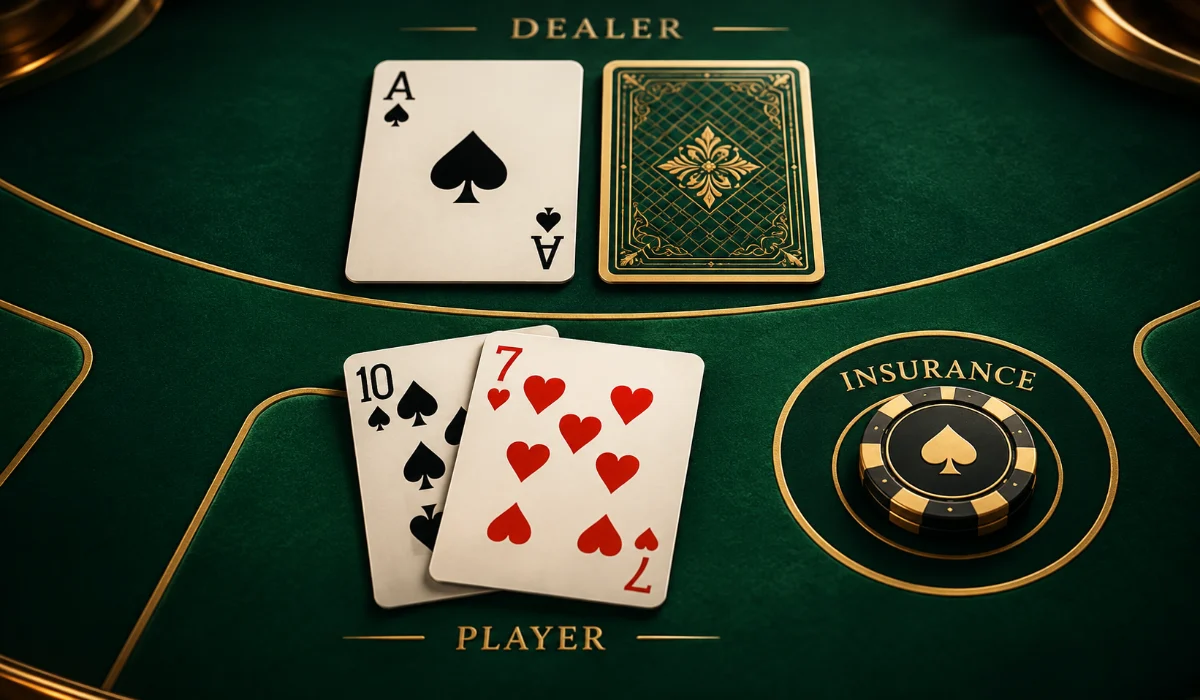
Direct Answer
Blackjack insurance is a separate side wager that may be offered when the dealer's visible card is an Ace. It generally relates to whether the dealer's hidden card completes a blackjack.
Para sa kaugnay na paliwanag, basahin ang Table Games: Roulette, Blackjack at Baccarat.
It is not the same wager as the player's original hand.
Insurance is a wager on a specific dealer outcome, not a promise that the round cannot lose money. To understand it, record the main stake and the extra insurance stake separately, then add their final net results.
Visual Example
Dealer:  A♠ + ?
Player: 10♥ + 8♦

Main hand:      18
Insurance:      separate decision
The table rules determine the insurance amount, payout, and settlement.
When Insurance Appears
A typical blackjack interface may offer insurance after:
- the initial cards are dealt;
- the dealer shows an Ace;
- the player is given a short decision window.
The exact sequence can differ between table versions.
Main Bet vs Insurance Bet
These two wagers can settle separately.
For example, the insurance wager may have one result while the original blackjack hand continues under its normal rules.
This is why a player should not assume that winning or losing insurance automatically determines the main hand.
What to Check
Before using any side wager, the reader should check:
- insurance stake limit;
- stated payout;
- dealer-peek procedure;
- whether the table offers insurance at all;
- how a dealer blackjack settles the main wager.
Why Side Bets Need Extra Attention
Side bets introduce an additional amount at risk.
A clear interface should show the amount before confirmation rather than hiding it inside the main stake.
The ordinary offer and what its name leaves out
Bicycle's published blackjack rules describe the common arrangement: when the dealer shows an Ace, insurance can be offered for up to half the original wager and pays 2 to 1 if the dealer's hidden card completes blackjack. This is a rule example, not a statement that every blackjack variation offers the same option.
Exact rules can vary by provider or operator, so check the game terms. Identify the allowed insurance amount, payout, decision countdown and dealer-check procedure. An offer appearing beside the main hand does not make it part of the original stake.
The hidden card must satisfy the insurance condition. A dealer who later reaches 21 using several cards is a different event from an initial two-card blackjack. Likewise, a dealer Ace does not tell you which ten-value card, if any, is underneath it.
Practical Example 1: what a 2-to-1 payout actually returns
Take a fictional 100-unit main wager and a separate 50-unit insurance wager. Assume insurance pays 2 to 1 profit and the dealer has blackjack. Insurance returns the 50-unit insurance stake plus 100 units of insurance profit: 150 back from that side wager.
If your main hand is an ordinary 18, it loses its 100-unit stake under the example's rules. Across both wagers you put up 150, and receive 150. The net round result is zero. The insurance line won, but the round did not produce 150 units of profit.
Now suppose the dealer does not have blackjack. The 50-unit insurance stake loses. Your original hand is then settled under its own rules. A main-hand win of 100 profit produces +50 after the insurance loss, while a main-hand loss of 100 produces -150 overall. The extra wager can reduce a winning round's net result or enlarge a losing one.
Two wagers, several combined outcomes
The table uses the same invented stakes and ordinary even-money main-hand win. It is not a prediction of how frequently these situations occur.
| Stated scenario | Main-hand net result | Insurance net result | Combined net |
|---|---|---|---|
| Dealer blackjack; player's ordinary hand loses | -100 | +100 | 0 |
| No dealer blackjack; main hand wins | +100 | -50 | +50 |
| No dealer blackjack; main hand pushes | 0 | -50 | -50 |
| No dealer blackjack; main hand loses | -100 | -50 | -150 |
Track the net amounts consistently. Mixing an insurance gross return with a main-hand net loss would overstate the result because the returned insurance stake would be counted as profit.
Practical Example 2: payout size alone does not show value
Consider only a fictional 10-unit side wager paying 2 to 1 profit when its condition occurs. Each winning ticket earns 20 profit and each losing ticket loses 10. If 30 of 100 such hypothetical tickets win and 70 lose, the net is 30 × 20 minus 70 × 10, or -100 units.
The point is arithmetic, not an asserted insurance frequency. A payout twice the stake can still accompany a negative total across a sequence. To break even in this simplified model, the chance of winning must be one third: 2p minus (1-p) equals zero when p = 1/3.
An actual probability assessment would require the relevant game and card information. A recent streak of dealer blackjack results is not a substitute for that information. This guide explains the accounting rather than advising a card-counting system or promising an advantageous wager.
Insurance, even money and a player's blackjack
A player holding an initial blackjack against a dealer Ace can encounter an “even money” option at some tables. Read it as a specific settlement offer with its own conditions, rather than as a free addition to the normal blackjack payout.
For a hypothetical 3-to-2 blackjack table, compare the two possible main-hand situations before accepting any offer: the dealer also has blackjack, or the dealer does not. Then check what an extra insurance stake would cost and return under each. A table using a different natural-blackjack payout needs a different comparison.
Do not infer a premium payout merely from the screen showing 21. A three-card 21 and an initial two-card blackjack are different classifications. The soft versus hard hand guide explains Ace values and the distinction between a total and a natural.
Dealer check timing and player controls
Insurance is usually a separate timed decision in a live interface. Locate whether declining it simply continues the hand and whether an accepted amount appears in the ticket summary. Do not mistake the countdown for a requirement to add a wager.
Dealer-peek and other procedures affect when information becomes available. They do not let the player choose the hidden card. Learn the basic controls in the hit versus stand explainer rather than treating an insurance offer as an alternative name for taking another card.
Common mistakes and a pre-confirmation check
Avoid believing that insurance covers every main-hand loss, assuming that a dealer's later three-card 21 qualifies, or adding a gross return to a net-profit figure. Check the extra amount exposed before pressing confirm: a 100-unit main stake plus 50 insurance places 150 at risk in the round, not 100.
If a settlement appears wrong, save the table rules, round ID, initial dealer card, accepted insurance amount and both settlement lines. Keep any other optional wagers separate. The live-casino side-bet guide explains that broader distinction without turning every side wager into the same product.
A decision to decline an additional wager does not require replacing it with a larger main stake on the next hand. Keep the round's spending within the limit set before play.
FAQs
Does a dealer's three-card 21 normally win insurance?
The ordinary insurance condition concerns dealer blackjack on the initial two cards. Check the exact rule rather than using the final total alone.
Why did my main-hand win produce less profit than expected?
A losing insurance stake can reduce the round's combined net result. Inspect both wager lines.
Is the insurance amount included in the original stake?
It is a separate added stake in the ordinary offer. Confirm whether the interface shows each amount and their total.
Does a 2-to-1 payout prove the wager is favorable?
No. Value also depends on how often the condition occurs. The illustrative break-even calculation is not a claim about the probability at your table.
Reader Safety and Verification
Scatter Panalo is an independent informational website, not a casino, sportsbook, payment processor, or regulator. Any operator-specific game, payout, odds, payment, licensing, or promotion detail should be checked against current primary sources before publication.
Gaming is for persons 21 years old and above only. Gambling can be addictive. Know when to stop.
PAGCOR's responsible-gaming information lists persons under 21 among those not allowed to gamble in covered gaming establishments and emphasizes harm prevention.
Sources and Verification Notes
- Bicycle blackjack rules, insurance section, support the common half-stake limit, 2-to-1 payout and separate-wager definition.
- Grand Ronde Gaming Commission game rules, blackjack chapter, provide a regulatory rules example. All monetary scenarios and the invented sequence above are educational calculations, not actual results or provider performance statistics.
Rule references checked: 28 October 2026. These sources explain the stated formats; they do not establish licensing, availability or eligibility at a particular operator.
Mga sanggunian at dagdag na mapagkukunan
PAGCOR resource links checked: . Ang mga link na ito ay resources; hindi endorsement o personal game testing.