

Direct Answer
A soft blackjack hand contains an Ace that can currently be counted as 11 without the hand exceeding 21. A hard hand either has no Ace or has an Ace that must be counted as 1.
Para sa kaugnay na paliwanag, basahin ang Table Games: Roulette, Blackjack at Baccarat.
This distinction explains why the same displayed total can behave differently after another card, and why a dealer can draw on one 17 but stop on another. Start by identifying the Ace value; a total alone does not describe the hand.
Visual Example
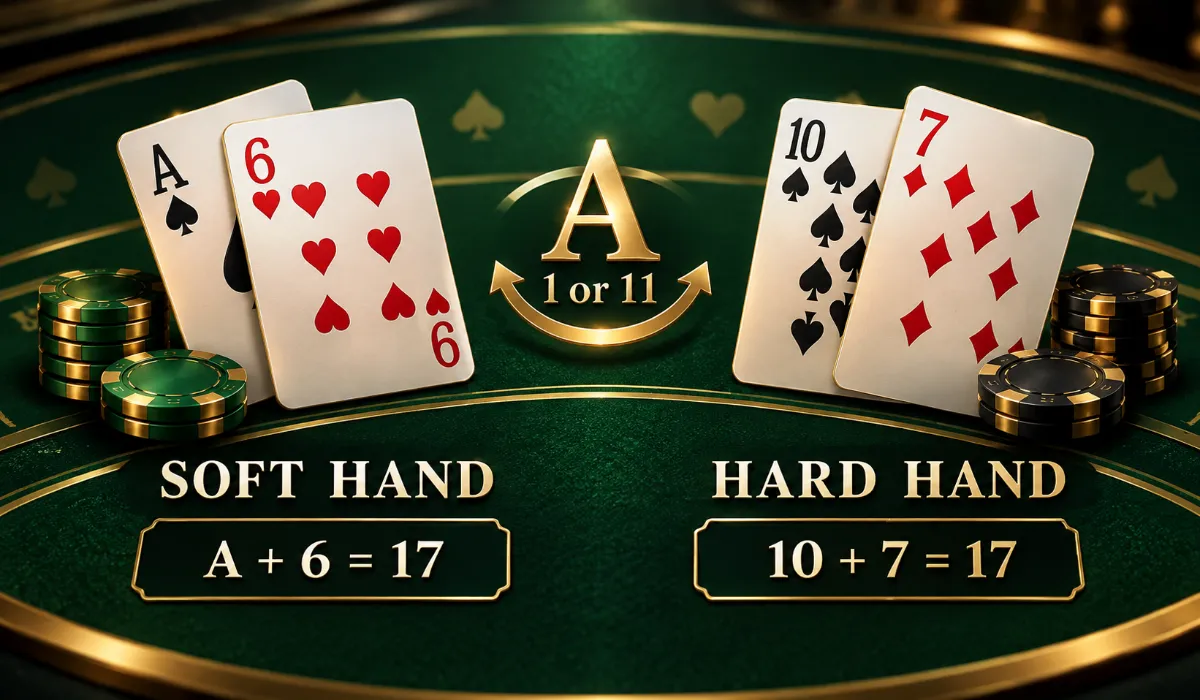
A♠ + 6♥   = Soft 17
10♦ + 7♣  = Hard 17
Both totals show 17, but they behave differently because the Ace in the soft hand can change from 11 to 1 if another card is drawn.
Why “Soft” Matters
Consider:
A♠ + 6♥ + 9♦
If the Ace stayed at 11, the total would be 26. Instead, the Ace can be counted as 1:
1 + 6 + 9 = 16
The hand becomes a hard 16.
More Examples
| Cards | Total | Type |
|---|---|---|
| A♣ + 5♦ | 16 | Soft 16 |
| A♥ + 9♠ | 20 | Soft 20 |
| 10♣ + 6♦ | 16 | Hard 16 |
| A♠ + 5♥ + 10♦ | 16 | Hard 16 |
Rules Still Matter
The definitions of soft and hard totals are standard concepts, but playing decisions can depend on table rules such as dealer behavior, doubling rules, number of decks, and other conditions.
Readers should therefore separate understanding the hand from choosing a strategy.
Live Casino Note
In a live-dealer table, the interface may show the current total automatically. The reader should still know why an Ace changes the total because it helps explain dealer and player actions.
A reliable way to calculate any Ace hand
Count every Ace as 1 first, then add the values of the other cards. If adding 10 keeps the total at 21 or less, one Ace can count as 11 and the hand is soft. Otherwise use the lower total and classify the hand as hard. This is a calculation method, not an instruction to take another card.
Only one Ace can count as 11 at the same time: two such Aces already total 22. Extra Aces still matter, but their presence does not automatically make a hand soft. Use the current cards rather than remembering how the hand began.
For example, A + A + 5 has a low total of 7. Adding 10 gives 17, so it is soft 17. A + A + 9 has a low total of 11 and an alternative total of 21: it is soft 21. With A + A + 10, the low total is 12 and adding 10 would give 22, so it is hard 12.
Practical Example: follow the same hand through three states
Imagine a fictional practice hand starting with A + 3. Its two usable totals are 4 and 14; the higher total is soft 14. After a 2 arrives, the cards total 6 or 16, so the hand remains soft. Another 9 makes the low total 15, while counting the Ace as 11 would produce 25. The hand is now hard 15.
The Ace did not lose a special property and the software did not change the rules. The cards changed which total fits below 22. If a 7 were then drawn, even the all-Aces-low total would be 22, so the hand would bust. The earlier soft status does not protect every later draw.
Compare a fresh soft 17, A + 6, with a hard 17, 10 + 7. Drawing a 9 produces hard 16 in the first example and 26 in the second. That difference is the practical meaning of flexibility. It does not establish that either draw is the right playing decision against a particular dealer card.
For the actions themselves, see the separate explanation of hit versus stand. Keeping arithmetic and action selection separate makes both easier to understand.
Dealer soft 17: read the table sign correctly
Two common labels are S17, meaning the dealer stands on soft 17, and H17, meaning the dealer hits soft 17. These labels describe the dealer's required procedure. They do not tell the player to copy the dealer, and they do not change what makes a hand soft.
Under an H17 rule, a dealer holding A + 6 draws another card. Under an S17 rule, the dealer stops with that hand. A hard 17 is a different case: do not read “hits soft 17” as “hits every 17.” The Grand Ronde Gaming Commission rules provide an official example of a table procedure requiring a hit on soft 17 and a stand on hard 17.
Exact rules can vary by provider or operator, so check the game terms. In addition to the soft-17 instruction, note the permitted doubles, splitting restrictions, deck configuration and blackjack payout. These are separate rule fields; one familiar label does not establish the rest of the rules.
A two-card blackjack is different from a three-card 21
An initial Ace plus a ten-value card is a blackjack under the ordinary definition. A hand such as A + 5 + 5 totals 21 but has three cards. A hand that reaches 21 after a split also needs the split-hand rule checked before assuming a natural-blackjack payout.
This matters when reviewing an account result. The number 21 alone does not tell you whether the hand was a natural, an ordinary total or a split-hand total. Save the card sequence and the bet type if a payout needs clarification. Optional wagers such as blackjack insurance are recorded separately from the main hand.
Common reading mistakes
- Treating every hand containing an Ace as soft, including A + 7 + 9, which is hard 17.
- Adding an extra 10 for each Ace instead of testing whether just one can count as 11.
- Assuming “soft” means profitable, safe or likely to beat the dealer.
- Following a strategy chart without matching its rule assumptions to the table.
- Treating an interface display such as 7/17 as two different wagers rather than two valuations of the same cards.
Quick table and interface check
Before using a live interface, locate the rules panel and identify how alternative Ace totals are displayed. In a practice hand, recalculate the value after each new card and check that your result agrees with the interface. A soft hand can stay soft or become hard; the type is not fixed at the initial deal.
If a total appears wrong, record all cards, the table name and the round reference before contacting support. A cropped screenshot showing only “17” omits the information needed to explain the result. The broader live casino guide covers the distinction between table information and account records.
FAQs
Can a hand with two Aces still be soft?
Yes. A + A + 5 is soft 17 because one Ace counts as 11 and the other as 1. Both Aces cannot count as 11 together.
Why does the screen show a lower total after a card arrives?
The Ace can be revalued from 11 to 1. For example, A + 6 + 9 is hard 16, even though the starting hand was soft 17.
Does the dealer's H17 sign apply to my own decisions?
No. It specifies the dealer's procedure. Player decisions and available actions follow their own rules.
Is a soft 21 always paid as blackjack?
No. The number of cards and whether they came from a split matter. Check the table's definition of an eligible natural blackjack.
Responsible Gaming Notice
Gaming is for persons 21 years old and above only. Gambling can be addictive. Know when to stop.
This article is educational and does not present gambling as a source of income or a guaranteed way to make money.
Sources and Verification Notes
- Bicycle's blackjack rules explain card values and the ordinary action terms.
- Grand Ronde Gaming Commission game rules, blackjack definitions and dealer procedure, document an H17 example. These are a reference for terminology, not a claim that every Philippine table uses the same rules.
Rule references checked: 28 October 2026. These sources explain the stated formats; they do not establish licensing, availability or eligibility at a particular operator.
Mga sanggunian at dagdag na mapagkukunan
PAGCOR resource links checked: . Ang mga link na ito ay resources; hindi endorsement o personal game testing.