

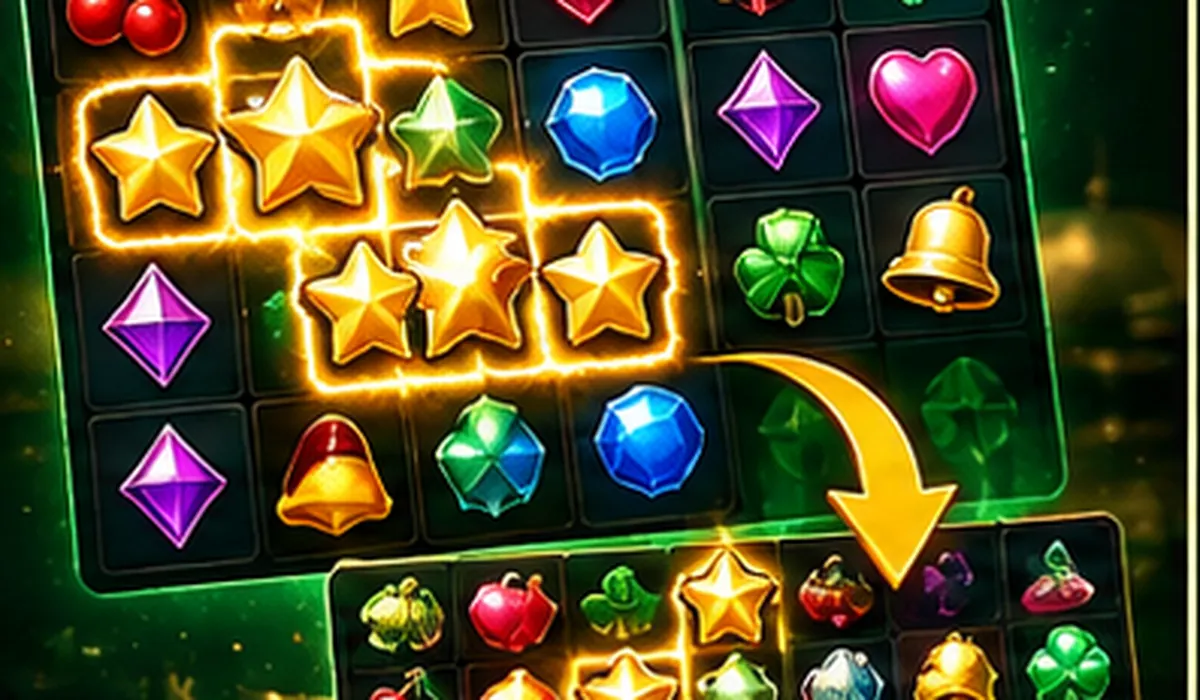
Cluster pays slots replace traditional paylines with groups of matching symbols. Instead of asking whether three symbols landed on a fixed line, the game checks whether enough matching symbols connect under its stated adjacency rules. That change sounds simple, but it affects how players should read the grid, the paytable, and any cascading feature that follows a win.
A useful way to think about cluster pays is this: the grid decides which symbols touch, the paytable decides how much a cluster is worth, and the feature rules decide what happens next. Those three layers should be read separately.
How a cluster win is formed
A cluster begins with matching symbols occupying neighboring positions. Many games count horizontal and vertical contact; some games allow other forms of adjacency. The minimum number of symbols can also vary. Five matching symbols is common, but it is not a universal rule.
The important point is that a cluster does not have to look like a straight line. It can form an L-shape, a block, a staircase, or another connected shape as long as the game’s connection rules are satisfied.
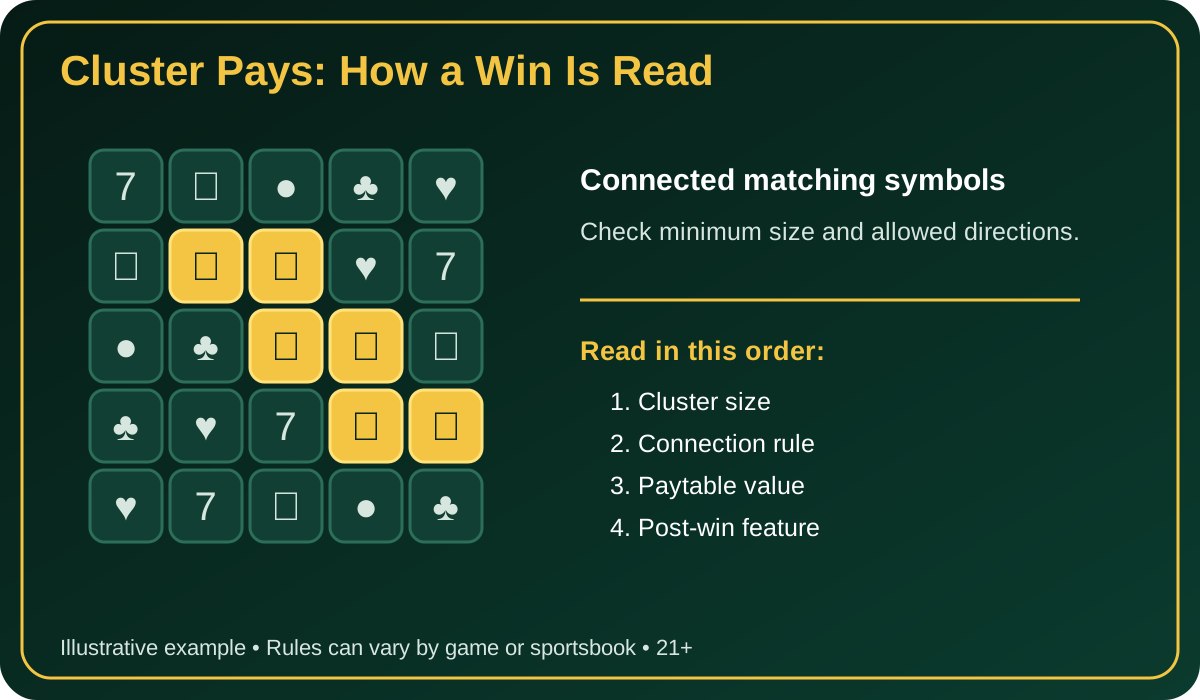
Read diagram text
- Cluster Pays: How a Win Is Read
- Connected matching symbols
- Check minimum size and allowed directions.
- Read in this order:
- 1. Cluster size
- 2. Connection rule
- 3. Paytable value
- 4. Post-win feature
- Illustrative example • Rules can vary by game or sportsbook • 21+
Practical Example
Imagine a 5×5 grid where six star symbols land in a connected shape. Four stars form a small square and two more touch the right edge of that square. If the game pays from five connected stars, all six may be evaluated as one cluster.
Now imagine another star on the opposite corner of the grid. Even though it is the same symbol, it is isolated. Unless the rules include a special connector or diagonal rule, that lone star does not automatically join the cluster.
This is why counting matching symbols across the whole screen can be misleading. Connection matters, not just quantity.
Cluster size and symbol value both matter
Most cluster games scale awards using two variables: the symbol involved and the size of the connected group. A cluster of a higher-value symbol can pay differently from an equally sized cluster of a lower-value symbol. Likewise, a larger cluster can move into a higher paytable band.
Before playing, open the paytable and check:
| Item to check | Why it matters |
|---|---|
| Minimum cluster size | Tells you when a group first qualifies |
| Allowed connection directions | Explains what “touching” means |
| Payout bands | Shows how larger clusters are valued |
| Wild behavior | A wild may substitute, connect, expand, or behave differently |
| Post-win feature | Cascades, transformations, meters, or respins can change the next state |
A common mistake is to see a large group of symbols and assume every symbol is part of one award. The game may split them into separate clusters if the groups do not touch according to the stated rules.
Cluster pays is not the same as cascading reels
These mechanics often appear together, but they answer different questions.
Cluster pays describes how a winning group is recognized. Cascading reels describes what happens after a win: winning symbols may disappear and new symbols can fall into the empty spaces.
A cluster game can theoretically exist without cascades, while a cascading game can use paylines, ways-to-win, or another payout system. Keeping the concepts separate makes feature-heavy slots much easier to understand.
Example of a cascade sequence
Suppose a spin creates one qualifying cluster. The game pays it, removes those symbols, and drops new symbols into the gaps. The new arrangement creates another qualifying cluster. That second cluster is a new evaluation created by the cascade, not proof that the first cluster “predicted” another win.
Some games add a multiplier that increases during consecutive cascades. Others use charge meters or unlock special symbols. Those rules are game-specific and should be read in the information panel rather than assumed from another title.
Cluster pays vs paylines vs ways to win
The three systems can look similar on a busy screen, but the logic is different.
| System | What creates a win? | Position rule |
|---|---|---|
| Paylines | Matching symbols on an active line | Must follow listed line patterns |
| Ways to win | Matching symbols on adjacent reels | Row often does not matter |
| Cluster pays | Connected group of matching symbols | Must satisfy adjacency rules |
For readers already familiar with paylines, the biggest adjustment is to stop tracing left-to-right line patterns. In a cluster game, the winning group can form in the center or another part of the grid depending on the rules.
How wilds can change a cluster
Wild symbols can make cluster games more complicated because “wild” is not one universal behavior. A wild may substitute for regular symbols, join a cluster, expand into nearby spaces, or transform symbols. Some games use special connector symbols that create links that ordinary symbols cannot.
Read the wild description separately from the normal cluster rule. If the game says wilds substitute for all standard paying symbols except scatters, that is different from a game where a wild becomes part of the largest adjacent cluster.
What the grid does not tell you
A visually crowded grid can feel “close” to producing a large cluster, but the displayed arrangement is only the result of the current spin. It does not show that the next spin is due to connect. Past clusters, near-misses, meters, and animations should not be treated as predictive unless the rules explicitly describe a persistent feature.
This matters because cluster games are designed to make groups and chain reactions easy to see. The visual feedback is useful for understanding the settled result; it is not a forecasting tool.
How to read a cluster slot before using real money
Start with the information screen rather than the animation. Identify the minimum cluster size, connection rule, symbol values, wild behavior, and whether cascades or multipliers reset after each paid sequence.
Then watch several demo or low-stake rounds if available. The goal is not to predict outcomes. It is to learn how the interface highlights clusters and how the game distinguishes one paid group from another.
A good quick checklist is:
- What is the minimum number of matching symbols?
- Do diagonals count?
- Can one symbol belong to more than one cluster?
- Does a wild connect groups?
- What triggers a cascade?
- Do multipliers reset after the sequence?
- Are bonus features triggered by scatters instead of clusters?
Common misunderstandings
“Five matching symbols anywhere should win.” Not necessarily. They normally need to connect under the game’s rules.
“Every cluster game uses a 7×7 grid.” No. Grid sizes and layouts vary.
“Cluster pays automatically means tumbling reels.” No. The payout system and post-win mechanic are separate.
“A bigger-looking cluster always pays more.” The paytable still controls value; symbol type matters too.
“A near cluster means the game is warming up.” The current grid does not establish what the next result will be.
Why this mechanic appeals to some players
Cluster pays can be easier to read visually than a long payline map because the game highlights one connected group. It also works naturally with puzzle-like grids, cascades, transformations, and growing features.
The tradeoff is that players need to learn a different vocabulary. Terms such as adjacency, cluster size, connected group, cascade, and transformation matter more than line number or reel row.
Quick Reader Checklist
Before leaving the guide, a reader should be able to answer three questions without opening another page: what creates a qualifying result, what changes from game to game, and what information on the screen is descriptive rather than predictive. If any of those points is unclear, use the game’s information panel before staking real money.
For slot mechanics, visual design can make two games look similar even when their mathematics are different. A familiar star, crown, WILD badge, meter, or multiplier should be treated as a label until the paytable explains its function. The same symbol can perform a different job in another title.
Related ScatterPanalo Reading
- Slot Games for the broader slot category
- RTP and Volatility for return and risk concepts
- Free Spins for bonus-round terminology
- What Is a Scatter? for scatter-symbol rules
- Game Guides for more explainers
Key takeaway
Cluster pays is best understood as a connection rule. First determine which matching symbols form a legal group, then check the paytable, then read any cascade or multiplier that follows. Once those layers are separated, the game becomes much easier to audit without relying on animations or assumptions.
FAQs
How many symbols are needed for a cluster win?
It depends on the game. Five is common, but some titles use four, six, or another threshold.
Do diagonal symbols count in cluster pays?
Only when the game rules allow diagonal adjacency. Many titles use horizontal and vertical contact only.
Are cluster pays and ways to win the same?
No. Ways systems normally care about matching symbols appearing on adjacent reels, while cluster systems care about connected positions on a grid.
Can wilds join a cluster?
Often yes, but the exact wild behavior is defined by each game.
Are cluster slots better than paylines?
Neither system is automatically better. They are different payout structures, and RTP, volatility, feature design, and personal preference still matter.
Responsible Play
Slot outcomes are uncertain. Mechanics, meters, multipliers, and previous results do not create a guaranteed next outcome. Set a spending and time limit before play, and treat the amount as entertainment cost rather than money that must be recovered. 21+ only.
Sources
- BetMGM guide to Cluster Pays systems, 2026
- Current provider/game help screens for any title being played
Mga sanggunian at dagdag na mapagkukunan
PAGCOR resource links checked: . Ang mga link na ito ay resources; hindi endorsement o personal game testing.