


Sic Bo is a three-dice casino game where players bet on characteristics of the next roll. Instead of choosing one “hand,” the table offers families of wagers such as Big, Small, specific totals, single numbers, doubles, and triples.
NUSTAR’s published Sic Bo guide in the Philippines describes the game as betting on the outcome of three dice and lists multiple wager types with different payouts. The core lesson is simple: each box on the table represents a different condition, and the payout should be read together with that condition.
How a round works
Players place wagers on the layout before betting closes. Three dice are then rolled or revealed, and the table settles every bet according to the resulting numbers.
A roll of 5, 2, and 4 has a total of 11. That same roll can be relevant to several wager families at once: a total bet, a single-number bet on 5, 2, or 4, and possibly a Big/Small result depending on the stated triple rules.
Big and Small
Big and Small are among the easiest Sic Bo bets to read.
A common rule defines:
- Small: total 4–10, except a triple;
- Big: total 11–17, except a triple.
The triple exception is important. If all three dice show the same number, the Big/Small bet can lose even when the numerical total falls inside the apparent range.
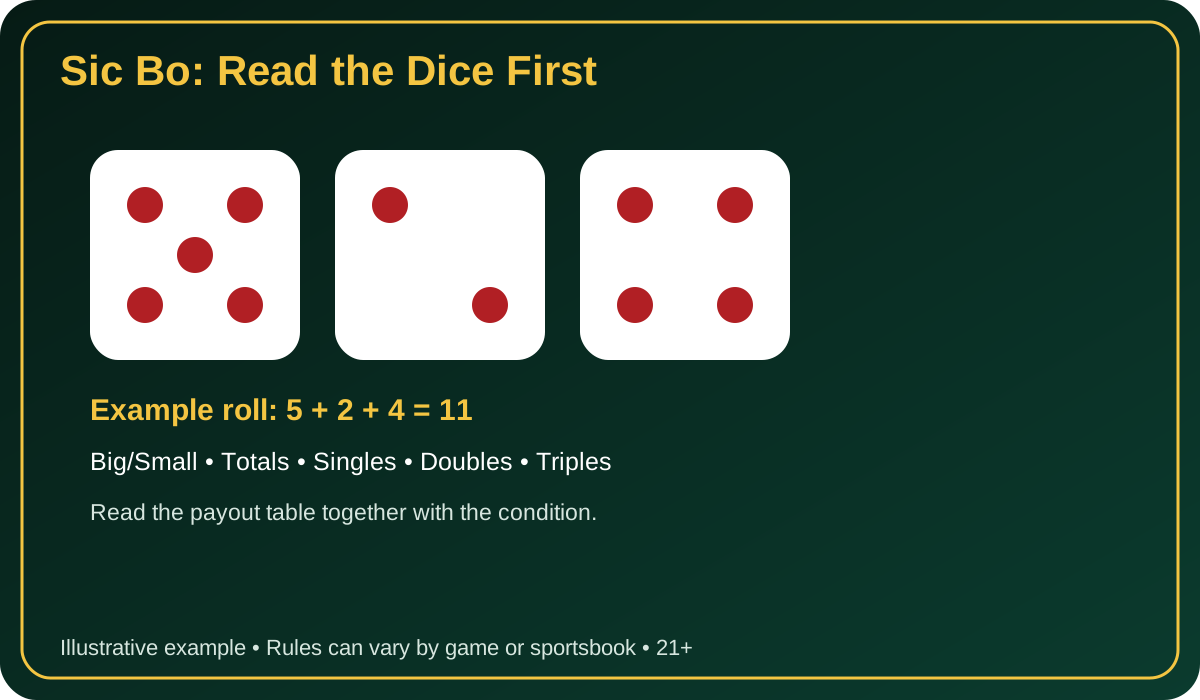
Read diagram text
- Sic Bo: Read the Dice First
- Example roll: 5 + 2 + 4 = 11
- Big/Small • Totals • Singles • Doubles • Triples
- Read the payout table together with the condition.
- Illustrative example • Rules can vary by game or sportsbook • 21+
Practical Example
Roll: 4 + 4 + 4 = 12.
Twelve looks like a Big total, but it is also a triple. Under the common rule above, the Big bet does not win because triples are excluded.
This is one of the most important table-reading details for beginners.
Single-number bets
A single-number wager predicts that a chosen face will appear on at least one die.
Some published Sic Bo tables scale the payout depending on whether the chosen number appears once, twice, or three times.
Example: the player selects 3.
- Roll 3-5-6: one 3 appears.
- Roll 3-3-1: two 3s appear.
- Roll 3-3-3: three 3s appear.
The exact payouts should be read from the table because casinos and game versions can differ.
Specific doubles
A specific-double bet predicts that a particular pair appears, such as two 4s. The third die can usually show another number unless the rules say otherwise.
This bet is more specific than simply choosing a single number, so the displayed payout is generally higher.
Do not confuse “specific double” with “any double.” If a layout offers both, one asks for a named pair while the other can accept any matching pair under its rules.
Specific triples and any triple
A specific triple predicts one exact triple, such as 6-6-6.
An any triple wins when all three dice match, regardless of the number.
Specific triples are harder conditions and can therefore display much larger payouts. The headline payout can look attractive, but it reflects a rarer event.
Total bets
Total wagers predict the combined value of the three dice.
The possible total ranges from 3 to 18, but many layouts offer totals from 4 through 17 separately because 3 and 18 are necessarily triples.
NUSTAR’s published table, for example, lists different payouts by total: extreme totals such as 4 or 17 pay more than central totals such as 10 or 11.
That shape makes intuitive sense because there are fewer combinations that produce extreme totals than middle totals.
Two-dice combinations
A combination bet predicts that two different named numbers both appear among the three dice, such as 2 and 5.
The third die can normally be another value. What matters is that the two selected faces are present.
This wager should not be confused with predicting the exact order of the dice. Sic Bo usually evaluates the presence of the selected numbers rather than left-to-right order.
Why payout tables matter
Sic Bo is not one single bet. It is a menu of bets with very different probabilities and payouts.
| Bet family | What you are predicting |
|---|---|
| Big / Small | A total range, normally excluding triples |
| Single number | A chosen face appears |
| Total | Exact combined value |
| Specific double | A named pair appears |
| Any triple | All dice match |
| Specific triple | One exact triple |
| Two-number combination | Two named faces both appear |
This table is more useful than memorizing one “best” area because the actual payout schedule can vary.
Practical Example: one roll, many results
Roll: 2-5-5.
Possible interpretations:
- total = 12;
- number 2 appears once;
- number 5 appears twice;
- specific double 5-5 is present;
- not a triple;
- Big may win under a common 11–17 rule.
One roll can settle several independent wagers. The player does not need to bet all of them.
Common mistakes
Ignoring the triple exception on Big/Small. This is the classic beginner error.
Assuming all totals pay the same. They do not.
Reading a two-number combination as exact order. Most layouts care about presence, not order.
Choosing a bet because its payout is largest. Large payouts usually correspond to rarer conditions.
Assuming online tables match a land-based payout sheet exactly. Check the in-game table.
Sic Bo and live casino
Sic Bo can appear as a physical table game, electronic table game, RNG game, or live-dealer-style product. The presentation changes, but the bettor still needs to read the wager definition and payout table.
PAGCOR’s live-dealer guidance treats live dealer games as outcomes derived from real-time human-dealer feeds rather than RNG-only results. If a Sic Bo product is labeled live, the interface should make the live source clear.
A simple pre-play checklist
Before placing a bet, confirm:
- Big/Small ranges;
- triple exclusions;
- exact payout for your chosen box;
- whether the game uses live or RNG presentation;
- table limits;
- whether side features alter the base rules.
Related ScatterPanalo Reading
Why middle totals appear more often than extreme totals
Three dice can produce many different combinations. A middle total such as 10 or 11 can be formed in far more ways than an extreme total such as 4 or 17. That is why published payout tables normally offer smaller returns on the central totals and larger returns on the extremes.
This pattern is useful for understanding the table even without memorizing every probability. The payout schedule is responding to how many dice combinations can create each result. It does not mean the game is “due” for an extreme total after several middle totals. Each new roll is settled from the new dice outcome.
One bet can overlap another without becoming a hedge
A player could place Big and also choose a specific number that can appear in a Big result. Those bets can both win on some rolls and split on others, but the overlap does not automatically protect the total stake. Each wager is settled independently.
For example, a 4-4-6 roll may satisfy a specific-double 4 bet while interacting differently with Big depending on the table’s triple exception and total rule. The correct approach is to read every wager as its own condition rather than assume multiple boxes cancel each other’s risk.
Key takeaway
Sic Bo becomes much easier once the layout is divided into bet families. Read the three dice, identify the condition each box represents, and verify the payout table. The largest number printed on the layout is not a shortcut to a better decision.
FAQs
How many dice are used in Sic Bo?
Three dice.
What is Big in Sic Bo?
A common rule uses totals 11–17 while excluding triples, but verify the table.
Does a triple count as Big or Small?
Under common rules, no. Triples are excluded from those bets.
What is a specific triple?
A bet that all three dice show one named number, such as 4-4-4.
Do Sic Bo payouts vary?
Yes. Use the current table’s published payout schedule.
Responsible Play
Sic Bo has many wager types with different built-in costs. Understanding the layout helps avoid rule mistakes but does not predict the dice. Set a spending and time limit before play. 21+ only.
Sources
- NUSTAR Resort Cebu: Sic Bo game guide
- PAGCOR guidelines on live dealer game contents
Mga sanggunian at dagdag na mapagkukunan
PAGCOR resource links checked: . Ang mga link na ito ay resources; hindi endorsement o personal game testing.