

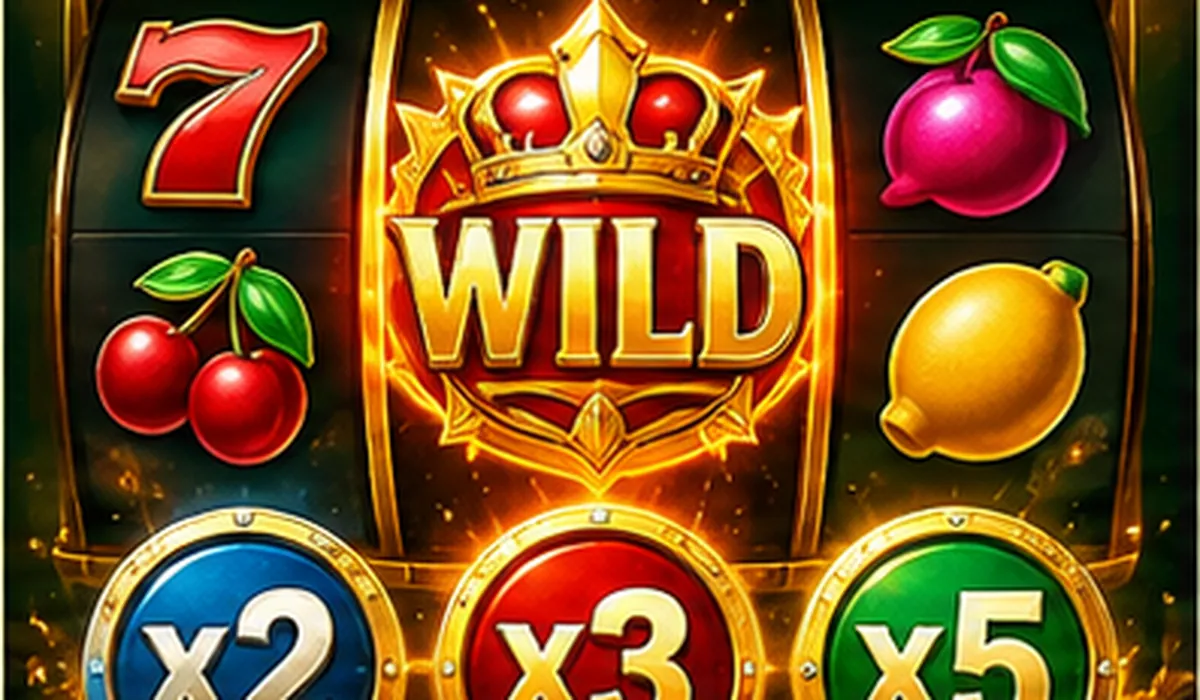
A wild multiplier is a special slot symbol or feature that combines two jobs: it can help complete an eligible winning combination like a normal wild, and it can multiply the value of that win when the game’s rules say the multiplier applies.
The important phrase is when the rules say it applies. A bright x2 or x5 badge does not mean every win on the screen is multiplied. The game may apply the value only to a line or way that actually uses the wild, only during free spins, only after a cascade, or only to one portion of a combined win.
Start with the normal wild rule
Before reading the multiplier, identify what the wild can substitute for. Many wilds replace standard paying symbols but not scatters, bonus symbols, or jackpots. Some wilds have their own paytable value. Others exist only to complete combinations.
A multiplier wild adds another rule on top of that substitution behavior.
Practical Example
Suppose a five-reel slot pays ₱100 for a particular winning combination. A x3 wild sits on one of the positions that forms that combination. If the rules state that any winning combination using the multiplier wild is multiplied by its value, the qualifying award becomes ₱300.
Now suppose another separate winning line on the same spin does not use that wild. The second line may remain at its normal value.
This is why the final total can be a mixture of multiplied and non-multiplied awards.
What happens when multiple multiplier wilds are involved?
There is no single universal stacking rule. A game can:
- add multipliers together;
- multiply them together;
- apply only the highest value;
- apply one multiplier per line;
- attach multipliers to different reels or positions;
- carry multipliers into later cascades or free spins.
Consider two multiplier wilds with x2 and x3. Under an additive rule, the result could become x5. Under a multiplicative rule, it could become x6. Never infer the formula from the graphics. Check the feature description.
Wild multiplier vs ordinary multiplier
An ordinary win multiplier can apply to all qualifying wins during a feature, even if no wild symbol appears. A wild multiplier is usually attached to a specific wild symbol or wild position.
Some games combine both. For example, a free-spins mode might have a global x3 multiplier while a x2 wild also joins a winning way. The rules determine whether those values stack, multiply, or are handled separately.
Wild multiplier vs expanding or sticky wild
These are different characteristics:
| Wild type | Main behavior |
|---|---|
| Multiplier wild | Increases a qualifying award |
| Expanding wild | Grows to cover more positions |
| Sticky wild | Remains in place for additional spins or steps |
| Walking wild | Moves across the reels under feature rules |
| Stacked wild | Occupies multiple adjacent positions |
One symbol can have more than one property. A sticky wild can also carry a multiplier, for example. Read each property independently.
Why free spins often change the rule
Providers frequently reserve stronger multiplier behavior for a bonus round. A base-game wild might substitute normally, while a free-spins wild can gain or increase a multiplier.
Big Time Gaming, for example, describes specific Megaways titles where wild multipliers persist or increase during feature play. That is a property of the named game, not a rule that should be assumed across all slots.
If the free-spins screen looks different from the base game, reopen the information panel and check whether wild values reset, persist, or accumulate.
Cascades can make multiplier timing important
In a cascading slot, one paid spin can create several evaluations. A multiplier may stay fixed for the whole cascade sequence, increase after each cascade, apply only when a multiplier wild participates, or reset after the sequence ends.
Illustrative sequence
A base spin creates a x2-wild win. The winning symbols disappear. A second cascade creates another win, and the feature increases the wild to x3. A third cascade misses.
The settled total is based on the exact awards at each step. The x3 shown at the end does not retroactively change the earlier x2 award unless the rules explicitly say so.
What to check in the paytable
The best wild-multiplier checklist is short:
- What symbols can the wild substitute for?
- Does the multiplier apply only when the wild is part of the winning combination?
- Are multiple multiplier wilds additive or multiplicative?
- Does the value persist during cascades?
- Does it reset on the next paid spin?
- Are free-spins rules different?
- Can the wild itself trigger a bonus?
These details matter more than the largest multiplier printed in promotional artwork.
Common misunderstandings
“A x5 wild multiplies the whole spin by five.” Not unless the rules say it applies to the entire spin total.
“Two x3 wilds always mean x9.” Stacking rules vary.
“Wilds replace scatters.” Often they do not.
“A multiplier that grew during a cascade stays for the next paid spin.” Many games reset it.
“A big multiplier guarantees a big payout.” The multiplier still needs a qualifying base award to act on.
How to compare two multiplier-wild slots
Do not compare only the maximum x-value. Look at how often the feature is active, which wins it can affect, whether values persist, and how the base paytable is structured.
A x100 multiplier that appears only under a rare feature can be a very different experience from a smaller multiplier that appears more regularly. The published RTP and volatility provide broader context but still do not predict a session.
Why recognizable symbols help
Wild multipliers are a good example of why game symbols should be recognizable in guides. A gold WILD icon plus x2, x3, and x5 markers instantly communicates the mechanic more clearly than a generic casino photograph.
On ScatterPanalo, illustrations should show the relationship between the wild and the multiplier without pretending to reproduce a specific provider’s interface unless an official screenshot is being used.
Related ScatterPanalo Reading
Reading multiplier scope from the win breakdown
When the interface provides a win history or breakdown, use it to see exactly where the multiplier was applied. A detailed result screen may show the base combination, the wild involved, the multiplier, and the final award. That is more reliable than trying to reverse-engineer the animation after several wins flash quickly.
For example, a spin might settle three separate ways: ₱40, ₱60, and ₱25. If a x3 wild participates only in the ₱60 way, the total would be calculated from the specific rules for that way rather than simply multiplying the whole ₱125 screen total. Some games aggregate the display differently, so the in-game history is the best place to verify the calculation.
Multiplier persistence should be treated as a state rule
A persistent multiplier is a value that remains active for more than one evaluation under stated feature rules. It can last for a cascade chain, a free-spins round, a sticky-wild sequence, or another defined state. Once that state ends, the value often resets.
This matters because players sometimes see a multiplier climb from x2 to x8 and assume the next paid spin will start at x8. If the feature has ended, that assumption can be wrong. The reset condition should be as important as the maximum multiplier when reading the feature description.
A final check is whether the multiplier is shown before or after the base win is calculated. Clear interfaces normally expose both values in the win breakdown.
Key takeaway
Read a multiplier wild as a rule attached to a qualifying symbol, not as a blanket multiplier for the screen. Identify the wild’s substitution role, then the multiplier scope, then the stacking and reset rules. That order prevents most confusion.
FAQs
Does a wild multiplier multiply scatter wins?
Usually not unless the game explicitly allows it.
Can two multiplier wilds combine?
Yes in many games, but the formula varies.
Do multiplier wilds stay during free spins?
Some do. Others reset every spin or every cascade sequence.
Is a bigger multiplier always better?
Not by itself. Frequency, paytable values, volatility, and feature rules matter.
Where can I verify the multiplier rule?
Use the game’s information or paytable screen for the exact version being played.
Responsible Play
Slot outcomes are uncertain. Feature knowledge helps explain settlement but does not predict the next result. Set a time and spending limit before play. 21+ only.
Sources
- Big Time Gaming official game feature descriptions
- Current in-game paytable and information screens
Mga sanggunian at dagdag na mapagkukunan
PAGCOR resource links checked: . Ang mga link na ito ay resources; hindi endorsement o personal game testing.